What Size Felt Pads for Chair Legs: Measure and Match
Updated November 21, 2026
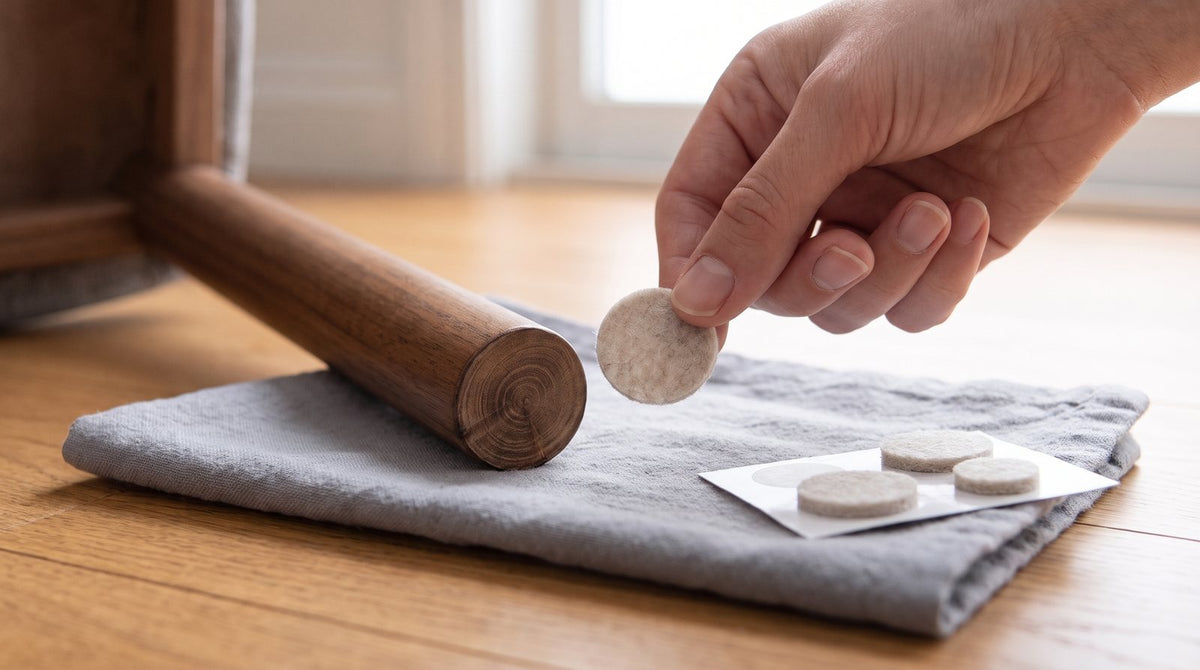
What size felt pads for chair legs you need comes down to one measurement: the width of the flat bottom of the leg, where it touches the floor. Choose the largest pad that is no wider than that flat bottom, so no felt hangs over the edge where it can catch and peel off.
Short answer: turn the chair over, measure straight across the flat end of one leg, and pick the biggest pad that fits inside that measurement. A leg that ends 25 mm (about 1 in) across takes a 22 mm (7/8 in) pad. Square legs take square pads measured side to side, and chairs dragged every day hold better with a slip-on cap or a nail-on glide than with a stick-on pad.
Below: how to measure, a size chart that matches leg widths to pad sizes in millimeters and inches, what to do with square, tapered and odd-shaped legs, and when a stick-on pad is the wrong choice.
How to measure chair legs for felt pads
- Turn the chair upside down on a towel or rug so the leg ends face up.
- Measure only the flat end. Many legs taper toward the floor or have a rounded edge, so the part that touches the floor is narrower than the leg higher up.
- On a round leg, measure straight across the center of the end.
- On a square or rectangular leg, measure side to side, then front to back. Never measure corner to corner, which reads about 40% larger.
- Measure the front and back legs. A chair with turned front legs and plain back legs may need two sizes.
- Look at the chair from the front. If the legs lean outward, read the note on splayed legs below before you buy.
Millimeters are easier than inches for something this small. One inch is 25.4 mm, so a 22 mm pad is about 7/8 in and a 45 mm pad is about 1 3/4 in.
Without a ruler, stand the leg on a sheet of paper, trace around it and measure the tracing.
Slip-on caps and socks are sized differently, by the range of legs they stretch or slide over. For those, see how to measure chair legs for protectors.
What size felt pads do I need? The largest that does not overhang
The right felt pad covers as much of the leg end as it can without sticking out past it. Two things go wrong when the size is off.
Too big: the felt overhangs the leg. When the chair is dragged, that loose edge catches on rugs, thresholds and grout lines and pulls the adhesive away from the wood. It also collects dust along the rim.
Too small: the leg stands on a small patch of felt in the middle. The same weight presses on less felt, so it flattens sooner, and the bare rim of the leg sits closer to the floor when the chair tips back.
So when a leg falls between two pad sizes, take the smaller pad. A leg 26 mm across takes a 22 mm pad, not a 27 or 28 mm one. A thin ring of bare wood around the felt is fine.
Felt pad sizes: chart by leg width
Find the width of the flat bottom of your leg in the left column. The pad sizes are the ones Scuffo stocks, but pads from any brand follow the same rule.
| Flat bottom of the leg | Round leg | Square leg |
|---|---|---|
| Under 22 mm (0.87 in) | Smaller than our smallest pad: use a slip-on felt cap (10 to 30 mm, see below) | Slip-on square cap (fits from 19 mm, 0.75 in) |
| 22 to 26 mm (0.87 to 1.02 in) | 22 mm round | 22 x 22 mm square |
| 27 to 39 mm (1.06 to 1.54 in) | 27 mm round, or 28 mm round from 28 mm (1.10 in) | 22 x 22 mm square, or 30 x 27 mm rectangle from 30 mm (1.18 in) |
| 40 to 44 mm (1.57 to 1.73 in) | 40 mm round | 40 x 28 mm rectangle |
| 45 to 59 mm (1.77 to 2.32 in) | 45 mm round | 45 x 45 mm square |
| 60 to 84 mm (2.36 to 3.31 in) | Cut a circle from a 6 or 8 cm felt roll | Cut a square from a 6 or 8 cm felt roll |
| 85 mm (3.35 in) and wider | Cut a circle from a 10 cm felt roll (up to 100 mm, 3.9 in), or trim an 85 x 85 mm square | 85 x 85 mm square |
The 22, 28 and 45 mm rounds, the 22 and 45 mm squares and the 47 x 27 and 30 x 27 mm rectangles all come in one box of self adhesive furniture pads: 101 pieces in eight sizes, including a 150 x 97 mm sheet you cut to shape, in beige or brown. That suits a home with mixed furniture.
If every leg is the same size, round and square felt pads come one size per pack, from 90 rounds of 27 mm to 10 squares of 85 x 85 mm, in beige. The 27 and 40 mm rounds, the 40 x 28 mm rectangle and the 85 x 85 mm square in the chart, and the 84 x 42 mm rectangle for block feet, come from this range.
For feet 60 to 100 mm (2.36 to 3.9 in) across, cut your own from felt for bottom of furniture, a self-adhesive gray felt roll 100 cm (39.4 in) long, in widths from 4 to 10 cm (1.6 to 3.9 in). Stand the leg on the liner, trace around it and cut along the line with scissors.
Felt pads in US stores are often labeled in inches, such as 3/4, 1 or 1 1/2 inch. The same rule applies: a 1 inch pad is 25.4 mm across, so it needs a leg end at least 1 inch wide.
Square, tapered and odd-shaped legs
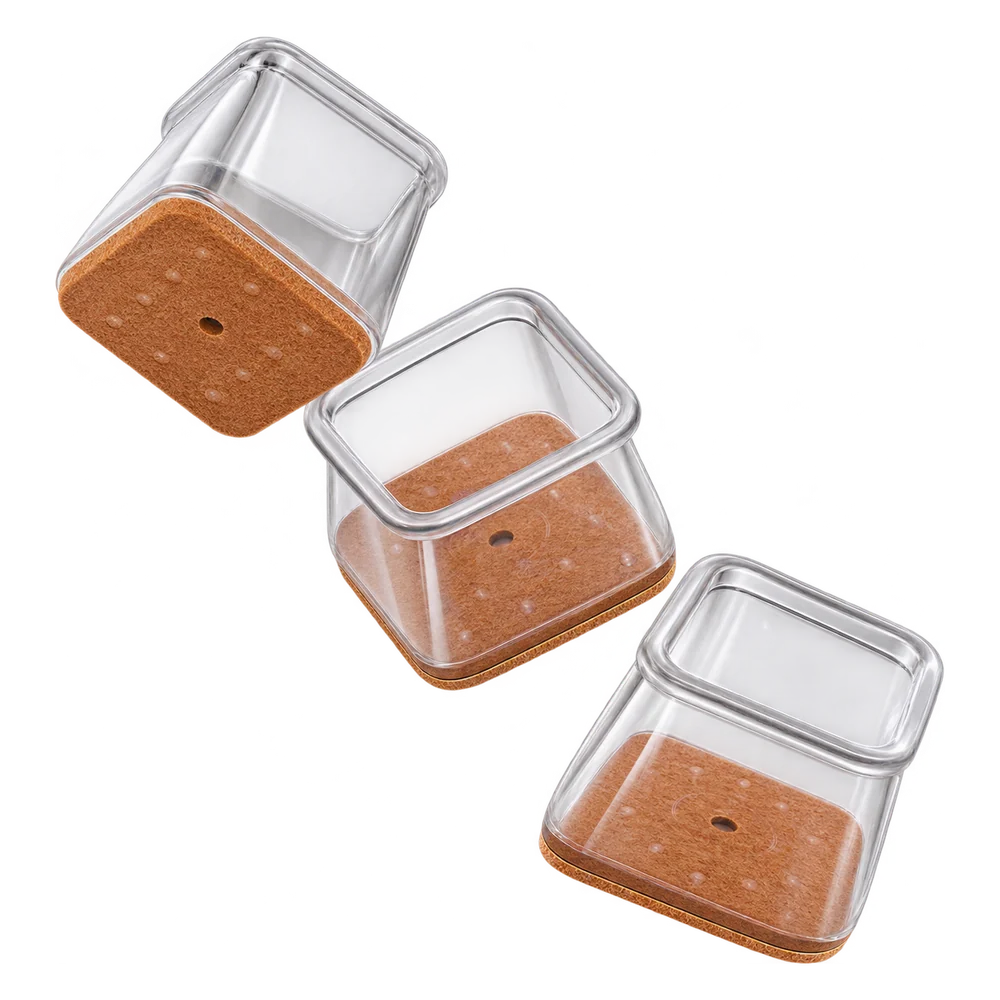
- Square legs: a square pad covers the corners, which are the sharpest part of the leg. A round pad also works if it is no wider than one side, but it leaves the corners bare.
- Tapered legs: measure the very bottom. A leg that is thick under the seat can end much narrower at the floor.
- Rounded or chamfered ends: only the flat center touches the floor, so size the pad to that flat area, not to the full width of the leg.
- Block feet and runners: long bases under dressers and beds take an 84 x 42 mm rectangle or a strip cut from a felt roll, which follow the shape better than a row of round pads.
- Splayed legs: a leg that leans outward meets the floor at an angle, so a flat pad rides on one edge whatever its size. Angled chair leg floor protectors hold the felt flat on legs that lean out by about 15 degrees and measure 20 to 35 mm (0.79 to 1.38 in) across.
When a stick-on felt pad is the wrong choice
Size is only half the job. Stick-on pads hold by adhesive alone, and a dining or kitchen chair that is dragged sideways many times a day can work even a well-sized pad loose. For those chairs, use something that cannot peel:
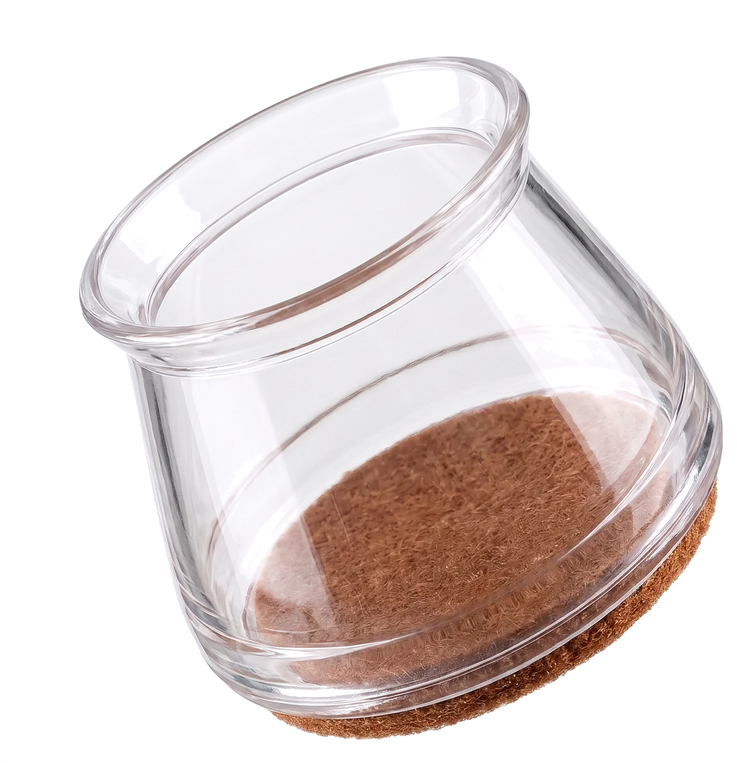
- Round legs 10 to 30 mm (0.39 to 1.18 in) across: slip-on round felt chair leg caps grip the outside of the leg and come in four overlapping size ranges.
- Solid wooden legs at least 20 mm (0.79 in) across: nail-on felt chair glides are 20 mm discs with a gray felt face and a center nail you tap into the leg end. On hard woods such as oak, drill a small pilot hole first.
Stick-on felt pads are the right choice for tables, desks, sofas, beds and cabinets that are moved now and then.
How to fit felt pads so they stay on
- Clean the leg end and let it dry. Dust, wax and old glue stop the adhesive from holding.
- Peel the pad off its backing without touching the sticky side.
- Center it on the leg end and press firmly for 30 seconds.
- Wait a few hours before you drag the furniture, so the adhesive can set.
Honest limits
- Our felt pad listings do not state a thickness, so we do not quote one. Size the pad by its width; thickness does not change the fit.
- Felt slides. It protects the floor, but it will not stop a chair from moving.
- Felt picks up grit, and grit in felt scratches like sandpaper. Replace a pad when it is flattened, worn through or dirty.
- Felt is for hard floors such as hardwood, laminate, vinyl and tile. On carpet it does little.
Questions
Should felt pads be bigger or smaller than the chair leg?
The same size or a little smaller. A pad wider than the leg overhangs, catches when the chair is dragged and peels off. Pick the largest pad that is no wider than the flat bottom of the leg.
What size felt pads do I need for dining chairs?
Measure the flat bottom of one leg and use the size chart above. Dining chairs are dragged every day, so stick-on pads can peel; dining chair leg protectors that grip the leg or nail in stay on longer.
How do I measure a square chair leg for felt pads?
Measure from one flat side to the opposite side at the very bottom of the leg. Corner to corner reads about 40% larger and leads to a pad that overhangs. On square legs of chairs that move every day, slip-on square chair leg caps stay on longer than stick-on pads.
What if my leg is between two felt pad sizes?
Take the smaller pad. A thin ring of bare wood around the felt does no harm; an overhanging edge catches and lifts the pad.
Can I cut felt pads to size?
Yes. Felt cuts with sharp scissors. For an odd shape, stand the leg on the backing of a felt sheet or roll, trace around it and cut along the line before you peel it.
What size is a 1 inch felt pad in millimeters?
25.4 mm across, so it needs a leg end at least 1 inch wide. For comparison, a 22 mm pad is about 7/8 inch and a 28 mm pad about 1 1/8 inch.