Are Bed Risers Safe? How to Raise a Bed Without Wobble
Updated November 25, 2026
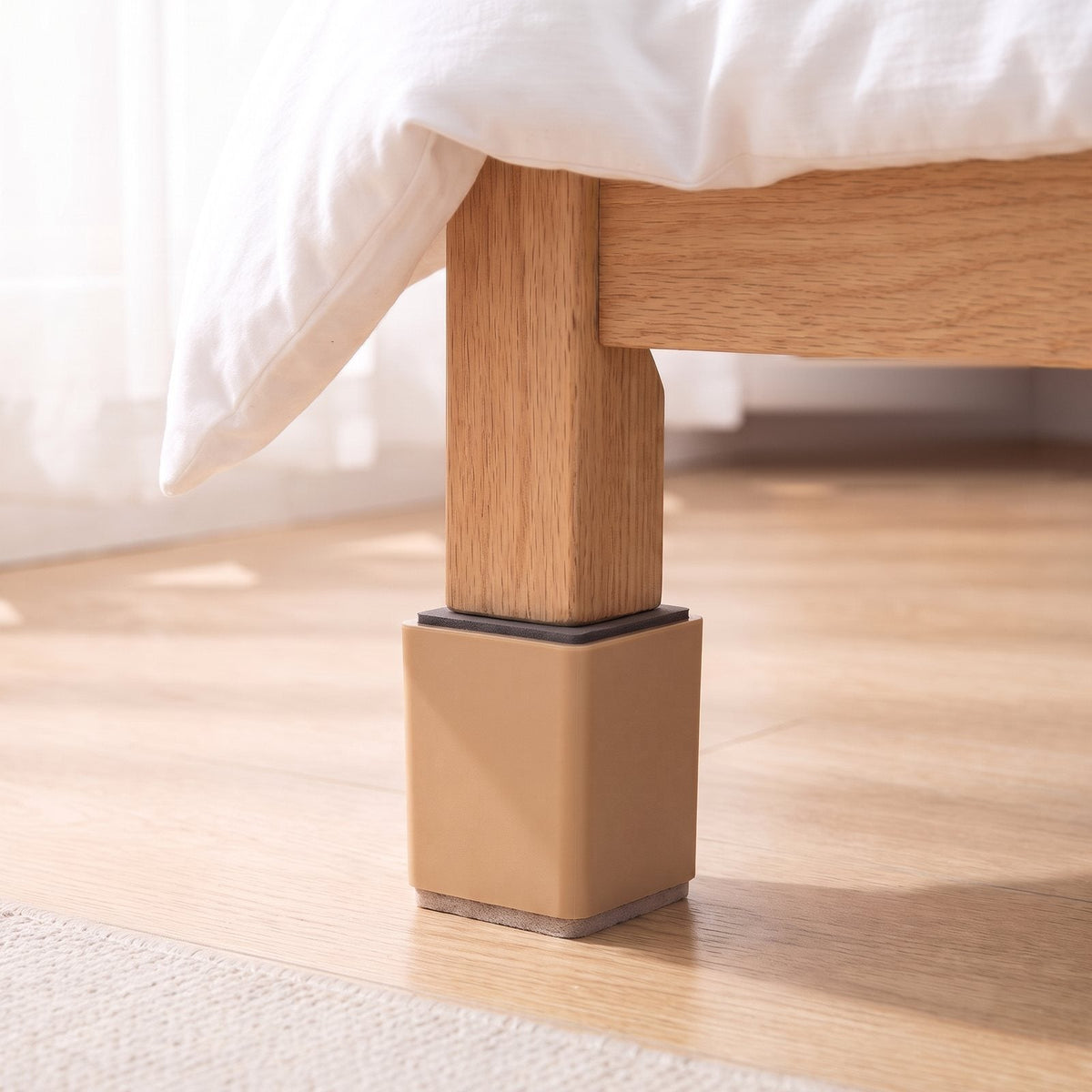
Are bed risers safe? They are when the whole foot of every leg sits flat on a riser, every leg including the center supports rises by the same amount, and the floor underneath is level and firm. Most problems come from a mismatch: a foot too big for the riser, a leg that ends in a wheel or a point, or center legs left on the floor while the corners go up.
Short answer: measure the bottom of each bed leg and choose a riser whose top is at least as wide as the foot. Raise every leg, center supports included, by the same height. Use risers only under flat feet, never under casters or angled legs. After fitting, sit on each corner and the middle of the bed: it should not rock, creak or shift. Check again after a week.
What makes a bed riser unsafe
- Overhang. A foot wider than the riser top rests on the edge, and weight on that side can tip the riser out.
- The wrong foot. Casters, ball feet, pointed feet and splayed legs that meet the floor at an angle do not sit flat on a riser.
- Center legs left down. Queen and king frames often have one or more center supports. If the corners rise and the center does not, the center rail hangs unsupported and the corner joints take all the load.
- Uneven heights. Mixing riser sizes, or one riser sitting on a rug edge, makes the bed rock.
- Soft or uneven floors. Deep carpet lets a narrow riser sink and lean.
- Stacking. Risers stacked on risers are not made to lock together.
Bed riser safety checklist
| Check | Why it matters | How to check |
|---|---|---|
| The foot fits the riser top | No overhang, so no tipping | Measure across the flat bottom of the leg and compare it with the riser top |
| Every leg is raised | The frame stays supported along its length | Count all legs, center supports included, before you order |
| All risers are the same height | No rocking | Use one size throughout and check with a level |
| Feet are flat | Full contact with the riser | Look at the leg end; casters and angled feet are out |
| Floor is firm and level | Risers stay upright | Avoid rug edges; on deep carpet, press each riser down |
| The frame is sound | Risers add height, not strength | Tighten every bolt; fix loose or cracked joints and broken center supports before raising |
| The bed does not shift | A sliding bed can walk off its risers | Sit hard on each corner; push the headboard against the wall |
Bed riser types, and how each one holds the leg
| Type | Lift | Holds the leg by | Suits |
|---|---|---|---|
| Fixed furniture risers, 2 inch | 2 in (50 mm) | An adhesive pad on a 1.57 in (40 mm) top | Flat round or square feet up to 1.57 in across |
| Adjustable furniture leg extenders | 2, 3 or 4 in, fine-tuned by a threaded cap | An adhesive disc on a top about 2 in (50 mm) across | Flat round feet up to about 2 in (50 mm) across, square feet up to about 1.4 in (35 mm) a side |
| Cup-style risers | Often 3 to 8 in | A recessed cup that the foot sits down into | Larger lifts, where a recess helps keep the foot in place |
Both of ours have a felt pad on the base, which protects the floor. Felt also slides more easily than rubber on a smooth floor, so if the bed shifts when you sit down, push it against the wall or read how to stop a bed from sliding.
How high can you safely raise a bed?
There is no single safe number; it depends on the riser, the frame and the fit. Our risers and extenders go up to 4 in (100 mm). Every extra inch raises the bed's center of weight and makes any overhang or rocking worse, so use the lowest lift that does the job. If you need much more, taller legs or a deeper foundation are steadier than a tall riser. Work out the height you want first with how to raise a bed.
How to fit bed risers safely
- Strip the bed and stand the mattress against a wall. A bare frame is far lighter and easier to lift evenly.
- Clean the bottom of each leg and let it dry, so the adhesive top can hold.
- With a helper, lift one end of the frame only as high as you need, set a riser under each leg and lower it onto the center of the riser top. Repeat at the other end, then the center legs.
- Press down on each corner so the adhesive takes hold, and give it time to set before loading the bed.
- Put the mattress back, then sit on each corner and the middle. Nothing should rock or creak.
- Check every leg again after a week of use.
What about weight limits?
Neither our 2 inch risers nor our leg extenders has a verified load rating, so we do not quote one, and nothing on this page means they are rated for a particular weight. The practical way to keep the load low on each one is to share it: raise every leg, including all center supports, and keep each foot fully on its riser. See all bed risers to compare the options side by side.
Honest limits
Risers are not made for beds on wheels, for adjustable power bases, or for bunk and loft beds, whose height is part of their safety design. If children use the bed as a trampoline, a riser is the weakest point, so keep the lift low or fit taller legs instead.
Questions
Are bed risers safe for heavy people?
It depends on the riser and the fit, and ours have no verified weight rating. Share the load: raise every leg including center supports, and keep each foot fully on its riser.
Can bed risers fall over?
They tip when a foot overhangs the top, the leg is angled or pointed, or the floor is uneven. A flat foot sitting fully on a riser on a level floor stays put.
Do you need to raise the center legs of a bed?
Yes. If the corners rise and the center supports do not, the center rails hang unsupported and the corners carry the load. Count them when you order.
Can you put bed risers on carpet?
Yes, but deep pile lets a narrow riser sink and lean. Press each riser down firmly, check the bed is level after a night, and prefer a wide base on thick carpet.
Are bed risers safe on a bed with wheels?
Not with the wheels standing on a flat riser top. Take the casters off if the frame allows and fit flat feet before raising it; otherwise leave it at its own height.